
Most garden lighting installs cover the obvious. Path lights along the driveway. Maybe a spike spot near the front door. Something at the back for when someone’s out on the deck.
Two categories consistently get skipped — not because homeowners don’t want them, but because nobody mentioned them. Outdoor wall lights and driveway lights both do things that ground-level fittings can’t, and both tend to transform the parts of a property that visitors see first.
What Outdoor Wall Lights Do That Ground Lights Don’t
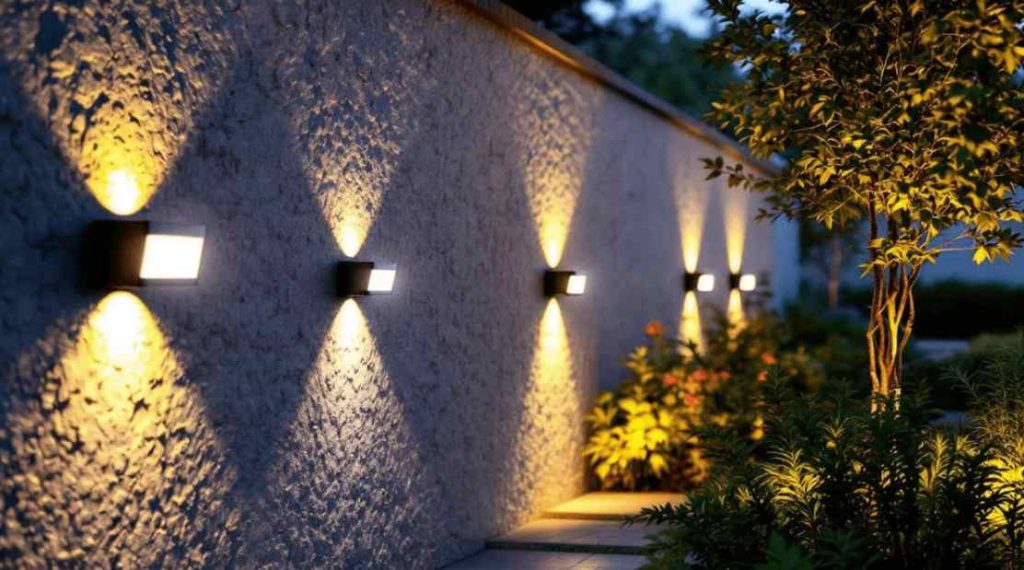
Garden lighting at ground level illuminates the floor plane. Wall lights introduce a vertical element — and vertical light is what gives a garden depth at night rather than just coverage.
A wall light mounted on a boundary fence and angled downward creates shadow along the ground that implies surface texture. One washing upward behind a planted border gives the garden a back wall — a sense of enclosure that makes an open space feel designed. A pair flanking a gate create an arrival moment that a single path light at ground level never produces.
Outdoor wall lights also operate at human scale in a way that ground fittings don’t. When someone is walking toward an entrance or standing in an outdoor entertaining area, the light comes from roughly the same height their eyes occupy. That changes the quality of the illumination entirely — from light you’re looking down at to light that’s actually in the environment with you.
Choosing the right wall light for a New Zealand exterior requires matching the fitting to the surface it’s mounted on and the effect it needs to create. Downward-facing fittings suit entrances, steps, and paths where safety is the priority. Upward or bidirectional fittings suit boundary and retaining walls where atmosphere is the objective.
Driveway Lights — The Category That’s Usually an Afterthought
Driveway lighting gets less attention than garden lighting in most project briefs, which is backwards. The driveway is the first thing a visitor encounters at night, the surface most used in the dark, and the one where adequate illumination most directly affects safety.
Driveway lights in New Zealand face the same environmental demands as any outdoor fitting — UV, rainfall, and coastal exposure where relevant — plus the specific challenge of being installed in a surface that vehicles drive over or park near. Ground-recessed driveway lights need to be rated for vehicle loadings. Spike or bollard fittings beside the driveway need to be positioned where they won’t be clipped by a vehicle turning.
Low-voltage systems are particularly suited to driveway lighting because the cable run is the main installation challenge. Flexible low-voltage cable can be run under the driveway surface at shallow depth during initial construction or laid alongside the edge in a cable duct during a retrofit, without requiring the conduit and depth that mains-voltage installation would need.
The effect goal for driveways is usually different from garden lighting. Not feature and atmosphere — consistent, safe illumination at a level that reads surfaces clearly without glare. Spacing matters: fittings too far apart create dark patches; too close and the effect becomes runway rather than driveway.
When Both Work Together
A property with outdoor wall lights at the entrance and well-positioned driveway lights along the approach creates a complete arrival experience at night — the kind that makes a house feel considered and cared for before anyone has set foot inside.
Neither category requires a large installation. A pair of wall lights flanking a gate and four to six driveway markers along a standard residential entry can be installed on the same low-voltage system as the main garden lighting scheme, drawing from the same transformer if it’s been sized with capacity in mind.
Frequently Asked Questions
What height should outdoor wall lights be mounted at?
For entrance lighting beside a doorway, 1.8-2m is standard. For boundary wall lighting, lower positions create longer shadows and more dramatic texture; higher positions produce broader, flatter coverage. The right height depends on the surface being lit and the effect required.
Are driveway lights able to handle vehicle traffic?
Ground-recessed driveway fittings need to be specifically rated for vehicle loadings — check the load rating before purchasing. Bollard and spike fittings beside the driveway don’t carry this requirement but should be positioned beyond the wheel track of a vehicle turning.
Can outdoor wall lights and driveway lights run on the same system?
Yes, in a low-voltage system with a correctly sized transformer. A specialist will calculate the combined load and specify transformer capacity with appropriate headroom. Undersizing the transformer is the most common cause of a lighting system that dims under full load.
The First Impression Matters
A property that’s well-lit along the driveway and at the entrance communicates something before anyone’s knocked on the door. Not just security — considered investment in how the place looks and feels at night.
Outdoor wall lights and driveway lights are the two elements most likely to shape that first impression. They’re also the two most commonly absent from an otherwise well-designed garden lighting scheme.
The Garden Lighting Company has been designing and installing outdoor lighting across Auckland for over 35 years — including outdoor wall lights, driveway lights, garden lighting, and path lighting. NZ-made, 10-year warranty. Get in touch at gardenlights.co.nz.